The challenge our clients face
A handful of manual call reviews each month, scorecards filled out by hand: quality is measured on just 2 to 5% of interactions. The rest flies under the radar, and issues only surface after they’ve already impacted countless customers.
And now that AI agents are responding to customers too, the question becomes even more critical: Who’s checking the quality of their responses?
What quality monitoring assesses
Quality monitoring is the systematic evaluation of every interaction to ensure your standards are upheld, no matter the advisor, AI agent, or channel. It covers three key dimensions:
Procedural compliance
Is every request handled according to your internal rules? Are the right steps followed, the right information provided, and the right cases escalated?
Tone alignment
Do your responses reflect your brand’s voice and maintain the same level of attentiveness, regardless of who’s responding?
Regulatory adherence
Are mandatory disclaimers, prohibited phrases, and critical steps consistently followed in every interaction?
The question isn’t whether you should measure customer service quality, it’s how to do it across 100% of interactions without investing disproportionate time.
Our solution to elevate your teams
Every customer service team has its own quality standards; iQ adapts to your criteria, scorecards, and organization.
iQ
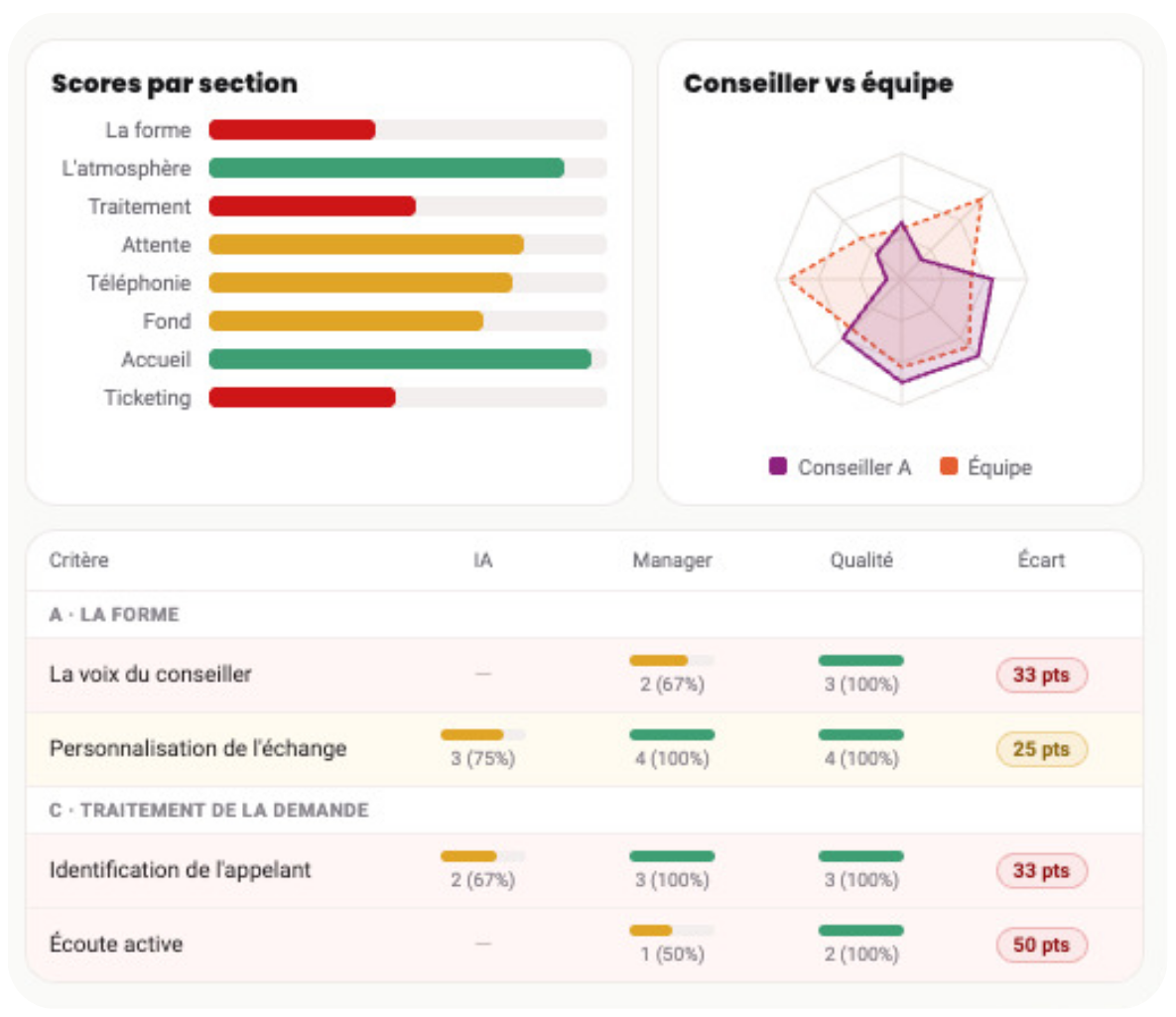
iQ evaluates 100% of interactions, calls, chats, tickets, and reviews, whether handled by human advisors or AI agents, using your own scorecards. Your manager, quality assessor, and AI rate the same interactions: iQ measures discrepancies, and you validate the benchmark score. Over time, the AI aligns with your criteria. Your AI agents are scored using the same frameworks, regardless of their provider, and iQ flags failures and out-of-scope requests. After training or a process change, you can immediately measure its impact on your teams’ scores.
Explore iQ- Full analysis of 100% of interactions, no sampling
- Customizable evaluation scorecards and automated scoring
- Compliance detection: mandatory disclaimers, prohibited phrases
- Blind human evaluation
- AI calibrated to your managers and quality experts
- AI agent supervision, regardless of provider
- Impact measurement of initiatives (e.g., training) on scores
- Dashboards and threshold-based alerts
Take it further
Quality monitoring: The complete guide
Definition, use cases, and best practices for integrating quality monitoring into your customer service strategy.
Read the articleUncover customer pain points
Quality monitoring evaluates your responses, while the voice of the customer analyzes what your customers actually experience. Both rely on iQ.
Learn moreTransition to augmented advisors
Kolaig assists your advisors in real time by providing the right procedures, while iQ measures interaction quality and drives long-term improvement.
Learn moreFrequently asked questions
What is quality monitoring in customer service?
It’s the systematic evaluation of every interaction (procedural compliance, tone, and regulatory adherence) to ensure your standards are met, regardless of the advisor, AI agent, or channel.
Why evaluate 100% of interactions instead of a sample?
Manual reviews cover just 2 to 5% of interactions, which can hide real gaps. Evaluating all interactions provides a complete, reliable picture and helps prioritize which interactions to review first.
Can you trust automated scoring?
iQ calibrates its AI to your experts: managers, quality teams, and AI rate the same interactions, iQ measures discrepancies, and you validate the benchmark. The AI aligns with your criteria over time.
Does iQ evaluate my AI agents too?
Yes. Using their transcripts, iQ scores your conversational agents with the same frameworks as your human advisors, regardless of provider, and flags failures and out-of-scope requests.
Which channels does iQ evaluate?
Calls (retrieved from your telephony system and automatically transcribed), chats, tickets (emails, forms), and customer reviews.
How long does it take to get my first evaluations?
Timing depends on volume and channel diversity. A scoping call will define a timeline tailored to your organization.
Is this relevant for my industry?
Yes, improving teams across 100% of interactions is a universal need, whether you’re a social housing provider, local authority, or business.