Artificial intelligence has transformed how we search, work, and even consume. Innovations keep coming, tools evolve rapidly, and they’re getting smarter by the day. The promises are compelling: time savings, productivity gains, cost reductions. Between those promises, occasional overenthusiasm, and real-world realities, it’s not always easy to separate fact from fiction. Here’s a clear definition of autonomous agents to help you understand what they are, what they can do, and form your own opinion.
Artificial intelligence has transformed how we search, work, and even consume. Innovations keep coming, tools evolve rapidly, and they’re getting smarter by the day. The promises are compelling: time savings, productivity gains, cost reductions. Between those promises, occasional overenthusiasm, and real-world realities, it’s not always easy to separate fact from fiction. Here’s a clear definition of autonomous agents to help you understand what they are, what they can do, and form your own opinion.
An autonomous agent is software that uses artificial intelligence to interact with its environment, make decisions, and act independently based on predefined objectives. The goal of an autonomous agent is to operate without human intervention while acting in the best interest of its owner.
Also known as AI agents, these systems range from simple rule-based programs to far more advanced solutions capable of adaptation and reasoning. They can function as basic assistants for repetitive tasks or as sophisticated tools that mimic human behavior. They can even handle tasks a human couldn’t manage alone due to time constraints, data volume, or processing limitations.
What sets autonomous agents apart from conventional software is their ability to make rational decisions based on their environment to achieve a specific goal. That environment may include internal knowledge bases (documents, business data, connected tools) as well as public sources like web pages, FAQs, or accessible online documentation.
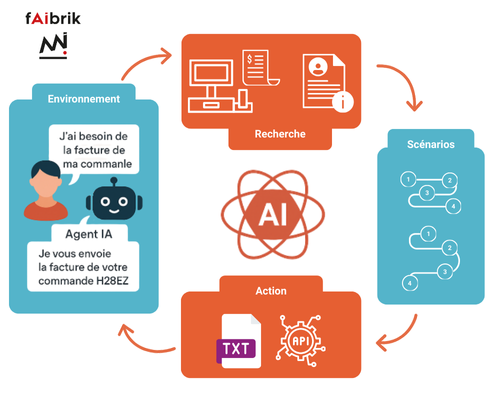
In practice, the agent interacts with its environment, considers all possible scenarios to reach its goal, analyzes them, and then creates a sequence of tasks to achieve that goal. It defines the steps to follow and executes them, adapting if something doesn’t go as planned.
What makes it 100% autonomous is that it doesn’t require a human-defined action plan to perform these tasks. The agent can handle the unexpected on its own, without needing every possible condition to be pre-programmed.
You may have already used one without realizing it. On tools like ChatGPT, Perplexity, or Gemini, some in-depth searches are managed by autonomous agents. They break down your question, analyze its meaning, explore multiple sources, and then synthesize a response as accurately as possible. That’s why some answers take a little longer to arrive.
These agents address some of the limitations of traditional software, which follows rigid, predictable scenarios with no real-time adaptability.
| Traditional Software | Autonomous Agent | |
|---|---|---|
| Configuration | Tasks defined in advance within a fixed workflow, following a “if A, then B” logic. No flexibility. | Initial setup is enough: the agent receives information about its environment and goal, then builds its own scenarios. |
| Operation | 1. Receives information (e.g., “Where is my order?”) 2. Evaluates conditions (e.g., “Is the order number provided?”) 3. Executes a pre-established scenario step by step. | 1. Analyzes its environment 2. Envisions possible scenarios 3. Chooses the scenario most likely to achieve the predefined goal 4. Develops an action strategy with underlying steps 5. Executes those actions 6. Adapts its strategy if needed |
| Tool Access | Limited to a set of connected applications via API. | Expanded access: can interact with various tools, search the web, or act within a browser. |
| Understanding | No comprehension capability, simply performs tasks. | Understanding is core to its operation: it reasons to define and adjust its actions. |
An autonomous agent can also collaborate with other autonomous agents to achieve a common goal. Each agent has a specific role and area of expertise to accomplish its mission. This creates a true artificial intelligence organization within the company. At fAibrik, we implemented such a system for one of our clients by combining two agents. The first generates content, while the second proofreads and optimizes it. The two agents interact until all the client’s defined criteria are met.
Customer service has become a cornerstone for businesses, and artificial intelligence naturally fits into this space. It already helps analyze, prioritize, and assign requests while significantly reducing response times. However, if poorly configured, it can lack nuance, empathy, or effectiveness in resolving tickets. Customer expectations, increasingly high and demanding, force companies to adapt to new standards. According to Accenture’s latest customer service study, 35% of respondents feared that AI would further degrade customer service quality in the coming years.
This is where autonomous agents come in. Their operation mirrors that of a human: they analyze, think, and undertake appropriate tasks. For example, in a customer service conversation about an issue, the agent can understand the request, act to satisfy the customer, and adapt to unforeseen cases while maintaining a consistent and empathetic tone.
These agents can intervene in both pre-sales and after-sales. In pre-sales, they can take the initiative to suggest products based on customer preferences or propose service improvements. In after-sales, they can identify a customer’s problem and offer tailored solutions to ensure satisfaction.
fAibrik and Citizen Call have teamed up to better understand how companies use AI agents in their customer relationships. Take part in our survey and receive our exclusive white paper on AI practices and trends in business to enhance customer experience.
To do this, we need your participation in a questionnaire aimed at companies with a customer service department, whether in-house or outsourced.
Don’t miss this opportunity to contribute and discover best practices in AI for customer relationships!
One of the primary benefits of autonomous agents is time savings for both customers and support teams. Available 24/7, these agents allow a business to remain reachable continuously, without interruption. Processing is fast because the agent quickly understands the context, makes a decision in real time, and provides a clear response without human analysis or validation delays. Your customers enjoy near-instant assistance, no matter the time.
At fAibrik, we created an autonomous agent for the social housing provider Haute Savoie Habitat. It directly answers tenants’ questions independently. Customer requests can be general or specific cases requiring data from a tenant file. The agent analyzes the request, identifies the required level of information, and then retrieves answers from internal tools or public sources.
This case perfectly illustrates the value of an autonomous agent in a context where requests are varied and hard to predict. Where a script or decision tree would hit its limits, the autonomous agent adapts to the situation by analyzing its environment and leveraging available tools, without relying on a pre-written scenario.
Their analytical, reasoning, and predictive capabilities enable them to adapt to complex, dynamic, and sometimes unpredictable environments. They can handle large volumes of information while maintaining consistent execution quality.
Where humans may be limited by fatigue, information overload, or scenario complexity, the autonomous agent remains efficient. It can process multiple data sources, extract relevant elements, cross-reference sources, anticipate possible developments, and act accordingly. This allows businesses to grow without weighing down their processes or compromising the quality of the service delivered.
By accessing a company’s internal tools, the autonomous agent can retrieve useful customer information and tailor its message accordingly. It considers the history of interactions, the customer’s profile, and the company’s communication tone. Responses are then consistent, personalized, and aligned with the brand image.
The agent can also adopt natural language, similar to a human’s. It can rephrase, add nuance, express empathy, and even adjust its language level based on the interlocutor. For the customer, the exchange remains fluid and natural, without feeling like they’re talking to a machine.
AI agents make decisions based on statistical analysis. Their approach is logical, rational, and optimized to achieve a specific goal. This leaves little room for intuition, industry experience, or human common sense.
Where a customer service representative relies on their experience, field knowledge, and similar cases, the autonomous agent follows a purely algorithmic process. It can make statistically effective decisions but may miss certain subtleties. The risk is losing the richness of human interactions: empathy, analytical finesse, or the ability to think outside the box to solve a problem creatively.
The cost of creating and operating autonomous agents from AI model providers like OpenAI, Mistral AI, or Anthropic is significant. This is a key factor to consider before getting started.
In fact, repetitive customer service tasks, such as order tracking, answering frequent questions, automatically responding to customer reviews, or resending an invoice, can easily be handled by traditional software, which is less expensive and just as effective.
Moreover, even if an autonomous agent has a form of memory, it systematically reanalyzes its environment with each new interaction. This means its entire thought and action process restarts each time, consuming more resources and potentially impacting the budget.
Entrusting tasks to an autonomous agent also means giving it access to your tools and, therefore, your customer data. If you use models provided by third-party companies, this access can pose security and confidentiality risks.
To mitigate these risks, it’s crucial to clearly define what the agent can and cannot do. This involves rigorous configuration of its environment and a solid understanding of data protection rules, particularly GDPR. A powerful but poorly managed AI can quickly become a vulnerability.
It can be tempting to use an autonomous agent to automate simple tasks. However, when dealing with a deterministic process, a sequence of identical actions, a traditional software solution is often more suitable. Assigning this type of task to an AI agent, which relies on probabilities, carries two risks: first, deviating from the defined process, even if well-trained; second, unnecessarily consuming computing and energy resources. Autonomous agents should remain a choice justified by the complexity of the use case. Otherwise, you risk making the wrong technological decision.
To fully understand how an autonomous agent works, it’s essential to know three key components: NLP, LLMs, and deep learning. NLP (Natural Language Processing) allows the agent to understand what a customer is saying. It identifies intent, key information, and the tone of the message. LLMs (Large Language Models) go further by generating tailored, natural responses. These models rely on deep learning, a technology that enables them to learn from billions of texts and adapt to different contexts. This is what makes an agent capable not only of responding but also of deciding, improving, and handling varied situations with human-like language.
To be truly useful, an autonomous agent can’t operate “message by message.” It needs contextual memory. This allows it to follow the thread of a conversation, remember what a customer said a few messages earlier, or keep track of important details like an order number or a specific request. At the same time, the agent can also rely on a knowledge base (a structured set of articles, rules, or documents) to find precise answers or verify information before responding. It’s this combination of contextual understanding and access to the right information that enables the agent to deliver a coherent, reliable, and truly personalized response.
Before diving in, it’s crucial to assess the scope of your needs. If your processes are clear, repetitive, easy to model in a decision tree, and everything works through API-connected tools, then traditional programmed software will likely suffice.
However, if you need to handle unpredictable situations, complex environments, natural language requests, or actions that fall outside the usual framework, autonomous agents are a serious option to consider.
If you’re torn between the two, you can count on fAibrik. Our AI platform for customer service adapts to your needs, whether for simple automation or more advanced agents. We help you make the right choice based on your needs, tools, and ambitions.
To discover how other companies are leveraging artificial intelligence, take part in our survey conducted in partnership with Citizen Call. In return, you’ll receive our white paper on AI practices and trends in business.